
Beyond a Single Comment
How residents can participate, what they should expect, and why local dialogue should continue

Standard Disclaimer: This newsletter is written in my capacity as an individual Port Angeles City Councilmember, Position 7. It represents my personal views, research, and understanding of municipal issues. It is not an official statement on behalf of the Port Angeles City Council or the City of Port Angeles. In compliance with the Washington State Open Public Meetings Act, comments are disabled to ensure that Council deliberation and public business remain within noticed public meetings. Please be advised that any communication sent to me regarding City business, including emails to jhamilton@cityofpa.us, may be considered a public record subject to disclosure under the Washington State Public Records Act.

Last week, a local Substack writer who publishes as Clallamity Jen contacted me after sharing one of my Monday videos. A reader had responded with a cynical view of the Port Angeles City Council and whether residents’ opinions have any real influence on public decisions.
Jen did not ask me to defend every decision made by the City or argue with the person who left the comment. She asked broader questions about why people often feel unheard, what residents can do when they have that experience, and what elected officials can do differently.
Those are fair questions, and they are not unique to Port Angeles.
Frustration with government is real. It should not be dismissed as ignorance, negativity, or an unwillingness to understand the process. People form their opinions of government through personal experiences that may include unanswered messages, conflicting information, long delays, confusing referrals, public comments that receive no visible response, or decisions that appear to have been settled before they had an opportunity to participate.
A resident may have spent weeks or months trying to address a concern. They may have contacted several offices, repeated the same information to different people, or been told that another department or government has responsibility. They may have spoken at a public meeting and left without knowing whether anyone considered what they said.
Since being appointed to the City Council almost eleven months ago, I have learned more about the difference between what government believes it is doing internally and what residents can actually see. Officials may be reviewing documents, asking questions, seeking clarification from the City Manager, or carrying an issue into a later budget or policy discussion. Unless some part of that work becomes visible, a resident may reasonably conclude that nothing happened.
Government cannot expect the public to simply assume that listening occurred. Public institutions have a responsibility to explain their processes, acknowledge their limits, and communicate how residents can remain involved.
What Public Comment Can (and Cannot) Do
Before joining the City Council, I had delivered public comment to the Council myself. I remember preparing what I wanted to say, trying to fit it within the time allowed, and wondering whether my words would have any effect on the decisions the Council was preparing to make that evening.
The experience did feel impersonal to me. I would speak, return to my seat, and the meeting would continue without a direct response. From the audience, it was difficult to know whether Councilmembers agreed, disagreed, had questions, or had already reached a conclusion.
Serving on the Council has helped me better understand why Councilmembers generally do not engage in a back-and-forth during the general public-comment period. Public comment is intended to give residents an opportunity to place concerns, information, and requests before the Council and into the public record. It is not structured as a question-and-answer session or an open debate between speakers and Councilmembers.
If Councilmembers responded at length to each person, meetings could quickly become uneven. One speaker might receive several minutes of discussion while another receives little or none. A comment may also raise factual claims, legal questions, personnel concerns, or administrative issues that cannot responsibly be evaluated from the dais.
Many concerns require staff information, review of an adopted policy, clarification from the City Manager, or examination of documents that are not available during public comment. An immediate answer may sound responsive while still being incomplete or inaccurate.
Certain land-use proceedings, appeals, and other quasi-judicial matters require additional caution. Councilmembers must remain impartial and base their decisions on the proper hearing record. A spontaneous exchange outside that process could create fairness concerns or introduce information in a way that is not appropriate.
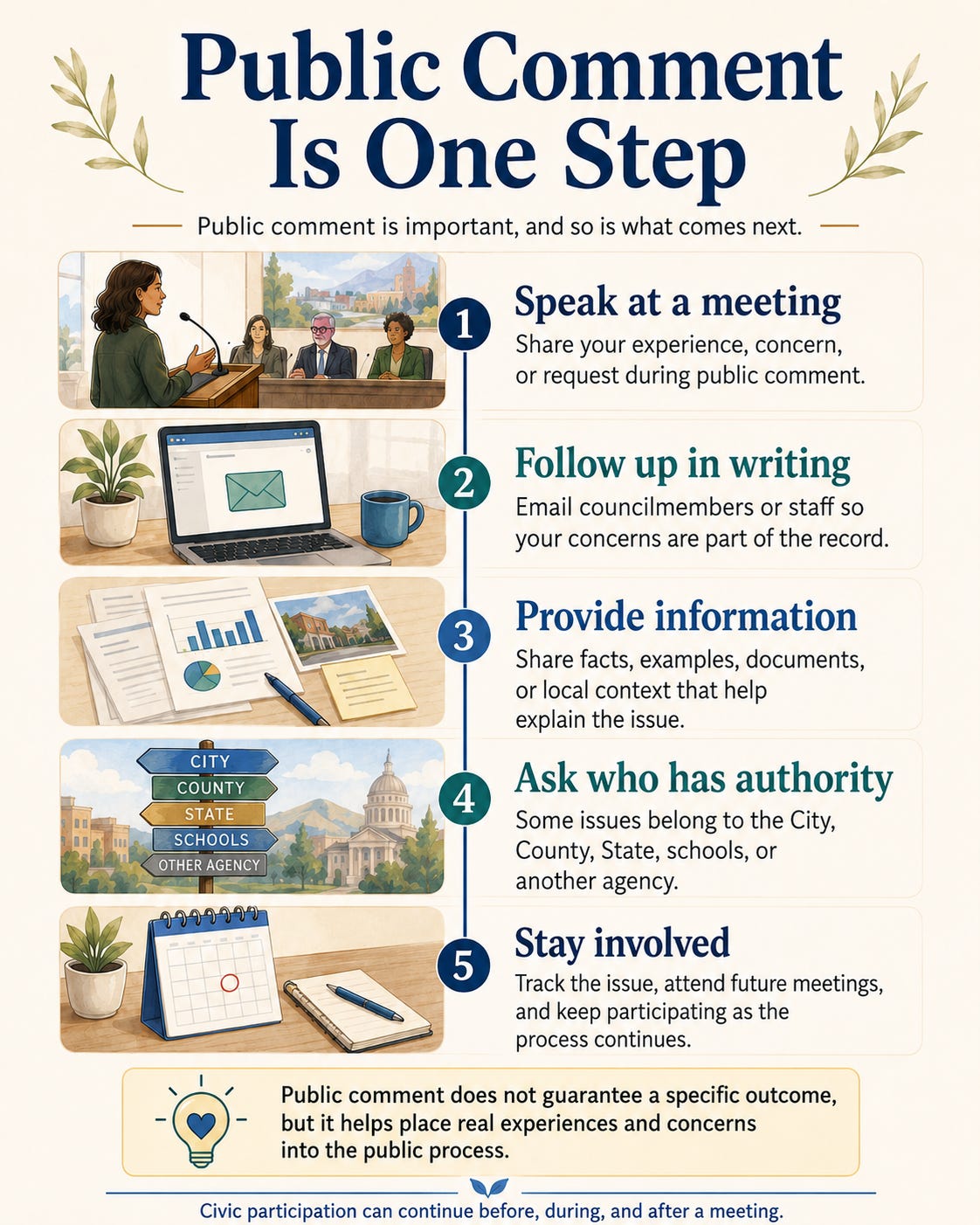
For those reasons, public comment may not produce an immediate response. Residents can still follow up in writing, provide supporting documents, ask who has authority, or continue participating as the issue moves through a committee, hearing, budget process, or later Council discussion.
Residents should reasonably expect that their comments will be received respectfully and considered with the rest of the public record. Public comment does not guarantee a particular result, but it should provide a genuine opportunity to describe an experience, identify a concern, question an assumption, or bring forward information before a decision is made.
When an Email Does Not Receive an Immediate Response
Elected officials receive emails covering a wide range of subjects. Some are short questions, while others include detailed histories, photographs, documents, links, or several requested actions. The concerns may involve City policy, County government, the school district, courts, state agencies, nonprofit organizations, private entities, or administrative work handled by the City Manager and staff.
I make an honest effort to respond to every email I receive, but I also recognize that this is not always possible or realistic. The volume can be high, and a useful response may require research, staff information, or a better understanding of which government has authority.
I do read each email word for word. I note the issue being raised, the information the writer wants me to understand, the points being made, and the action being requested. An email may lead to review of a staff report, an adopted plan, a budget document, or an existing policy. It may identify a question that should be raised with the City Manager or considered during a later Council discussion.
From the sender’s perspective, however, a lack of response can still feel like a lack of attention. Reading a message is not the same as acknowledging it or explaining what happens next. Residents should feel comfortable sending a respectful follow-up when they have not received an answer. A follow-up may return a message to attention during a busy period, clarify that a response is still being requested, or provide new information.
Residents should not be expected to prepare a formal legal argument. Explaining what is happening, how it has affected them, what they have already tried, and what action they are seeking is often enough to begin the conversation. Dates, locations, photographs, documents, and previous contacts can help identify the appropriate next step when they are available.
Finding the Government That Has Authority
Many issues brought to local elected officials cross jurisdictional lines. The City of Port Angeles, Clallam County, the Port of Port Angeles, the school district, Tribal governments, state agencies, courts, public authorities, nonprofit organizations, and private service providers may all have responsibilities connected to the same concern.
A road may be owned by the City, County, state, Port, or another entity. A criminal-justice concern may involve City police, the County jail, prosecutors, public defenders, courts, behavioral-health providers, or state law. A housing concern may involve City zoning, County services, a state agency, a landlord, a housing authority, or a nonprofit organization.
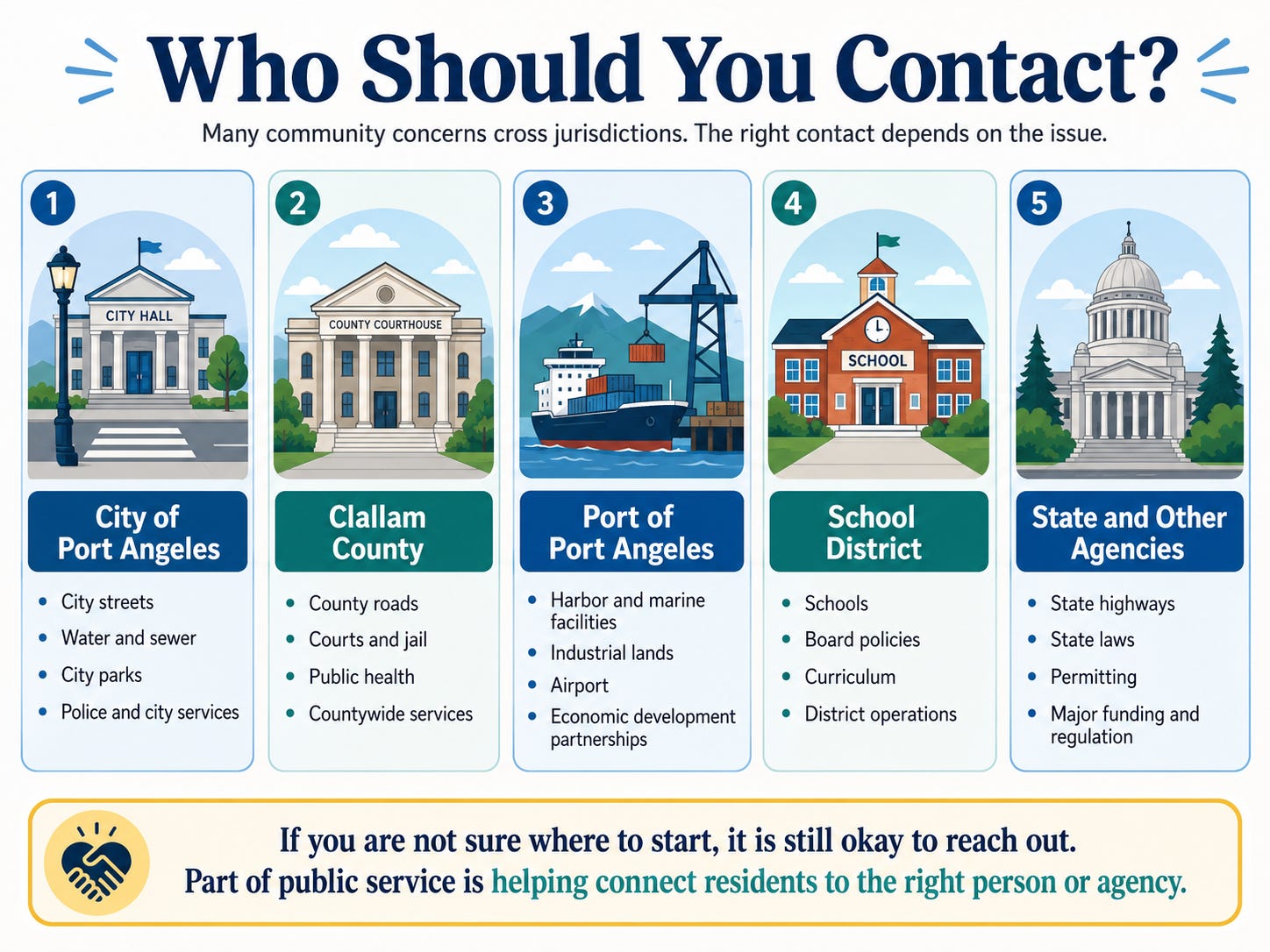
Residents should not be expected to understand every jurisdictional boundary before asking for help. Even people who are familiar with local government can find it difficult to determine who has authority, who should be contacted, and where a concern should begin.
Port Angeles operates under a council–manager form of government. The City Council adopts policy, passes ordinances, approves budgets and plans, sets utility rates, and approves major contracts. The City Manager and staff administer City operations, supervise employees, and implement Council policy.
An individual Councilmember cannot independently direct staff, promise a particular administrative action, or make a City decision outside a properly noticed Council meeting. A Councilmember can ask questions, raise policy concerns, review information, and help residents understand where authority lies, but should not cross into day-to-day administration.
When another government or institution has responsibility, residents should not simply be left with a closed door. Public officials should explain the boundary as clearly as possible and, when they can, direct the resident to the appropriate entity, official, department, or public process.
Residents can also ask direct questions: Who has authority over this issue? Is this a policy question or an administrative matter? Is there an existing review or hearing process? Who should I contact next? What information would help that person understand the concern?
Those questions can help turn a confusing referral into a clearer path forward.
Being Heard Does Not Always Determine the Outcome
There is a difference between being heard and receiving the outcome someone requested.
Elected officials often receive competing requests. One person may ask the Council to expand a service, while another asks us to reduce spending. One resident may support a project, while another believes the same project will negatively affect their neighborhood. Some people participate frequently and publicly, while others may be affected by the same decision but never contact the Council.
Councilmembers still have a responsibility to consider the law, adopted plans, staff analysis, budget constraints, public testimony, and effects on the broader community. The volume of emails or public comments can demonstrate the depth of concern surrounding an issue, but it does not by itself resolve the policy question.
From a resident’s perspective, however, a general statement that their concerns were considered may feel incomplete when the final decision goes in another direction. They may reasonably wonder which parts of their comments were accepted, which were questioned, whether the information they provided changed anything, and why other considerations ultimately carried more weight.
Elected officials will not always be able to respond in detail to every individual comment, but they should explain the broader reasoning behind their decisions. Residents should be able to understand what information was considered, what alternatives were available, what legal or financial limits applied, and how the decision fits within adopted policies and public responsibilities.
When the outcome differs from what residents requested, communication should not end with the vote. A clear explanation can help people understand how the decision was reached, even when disagreement remains.
Practical Ways Residents Can Participate
Residents do not need to be experts in municipal law, budgets, or government structure before participating. Personal experience can provide information that does not appear in a technical report, especially when it explains how a policy, service, or project affects someone in everyday life.
Timing can influence how much room remains to shape a proposal. By the time an ordinance, contract, plan, or project reaches a final Council agenda, months of technical review may already have occurred. Residents may be able to participate earlier through advisory-committee meetings, public hearings, surveys, open houses, planning processes, budget development, and review of draft documents.
Government has a responsibility to make those opportunities easier to find and understand. Residents should not have to monitor several websites and read hundreds of pages of technical material simply to know that a proposal is developing.
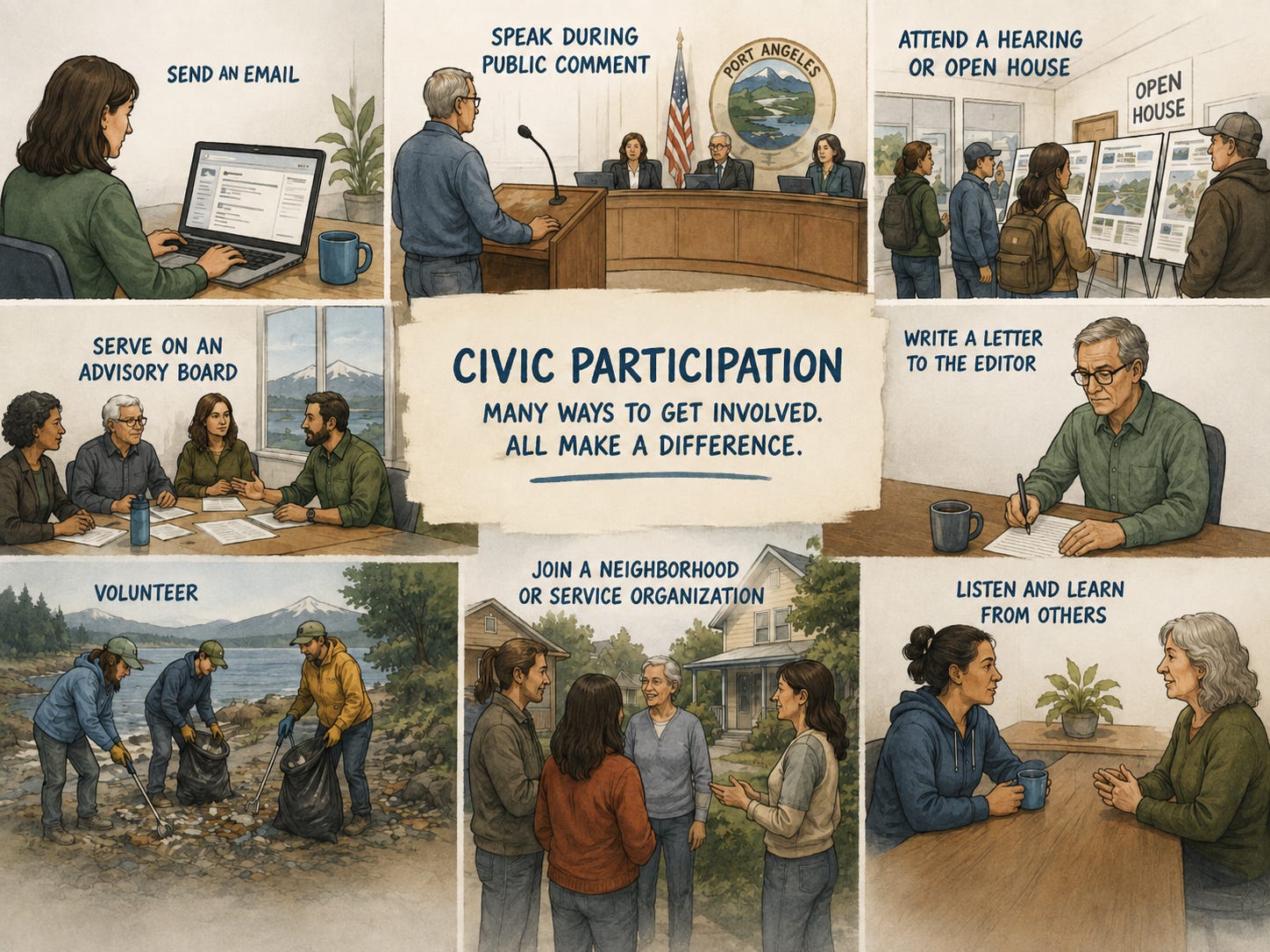
Residents who are especially interested in a particular subject should consider applying to serve on a City or County commission, committee, or advisory board. These bodies often spend more time reviewing a specific issue than the City Council or County Commissioners can devote during a regular meeting.
Members may study staff reports, hear presentations, ask detailed questions, receive public input, and make recommendations before a proposal reaches the elected body responsible for the final decision. Someone interested in housing, land use, transportation, utilities, parks, public safety, environmental protection, solid waste, arts, or another area of public policy may be able to contribute directly through one of these groups.
Serving on an advisory body can also provide a clearer view of how recommendations are developed, how competing concerns are considered, and how an idea moves through public review before reaching a final decision.
Writing a letter to the editor is another way to participate in civic discussion. A letter can raise an issue, describe a personal experience, question an assumption, support or oppose a proposal, or encourage others to become involved. It allows residents to communicate not only with elected officials, but also with neighbors who may not attend meetings or follow government agendas closely.
Civic Participation Beyond Government Meetings
Being involved does not always require writing to elected officials, attending every public meeting, or speaking during each public-comment opportunity.
People can volunteer, join a service organization, participate in a neighborhood group, help with a community cleanup, support a nonprofit, attend a public event, or listen to people whose experiences differ from their own. Conversations that happen through those activities can reveal concerns, ideas, and perspectives that may never appear in an agenda packet or formal presentation.
Community involvement also helps people understand how an issue affects others and what work is already taking place. It can connect residents with organizations, public employees, volunteers, and service providers who see different parts of the same challenge.
Sharing thoughts publicly can be difficult. Speaking at a meeting, submitting a letter, applying for an advisory body, or sending an email may leave someone feeling exposed. People may worry that they will use the wrong words, receive criticism, or discover that others strongly disagree with them.
Before I became a teacher, public speaking was not something I felt comfortable doing. Teaching required practice, repetition, and a willingness to continue even when I felt nervous or uncertain. Civic participation can develop in much the same way.
No one needs to begin as an expert or a confident public speaker. Participation can begin with attending one meeting, writing one letter, asking one question, volunteering for one event, or listening to one conversation. There is no single correct way to participate, and the most visible voices are not the only voices with useful experiences or ideas.
What Residents Should Expect From Elected Officials
The responsibility for public engagement cannot rest entirely with residents.
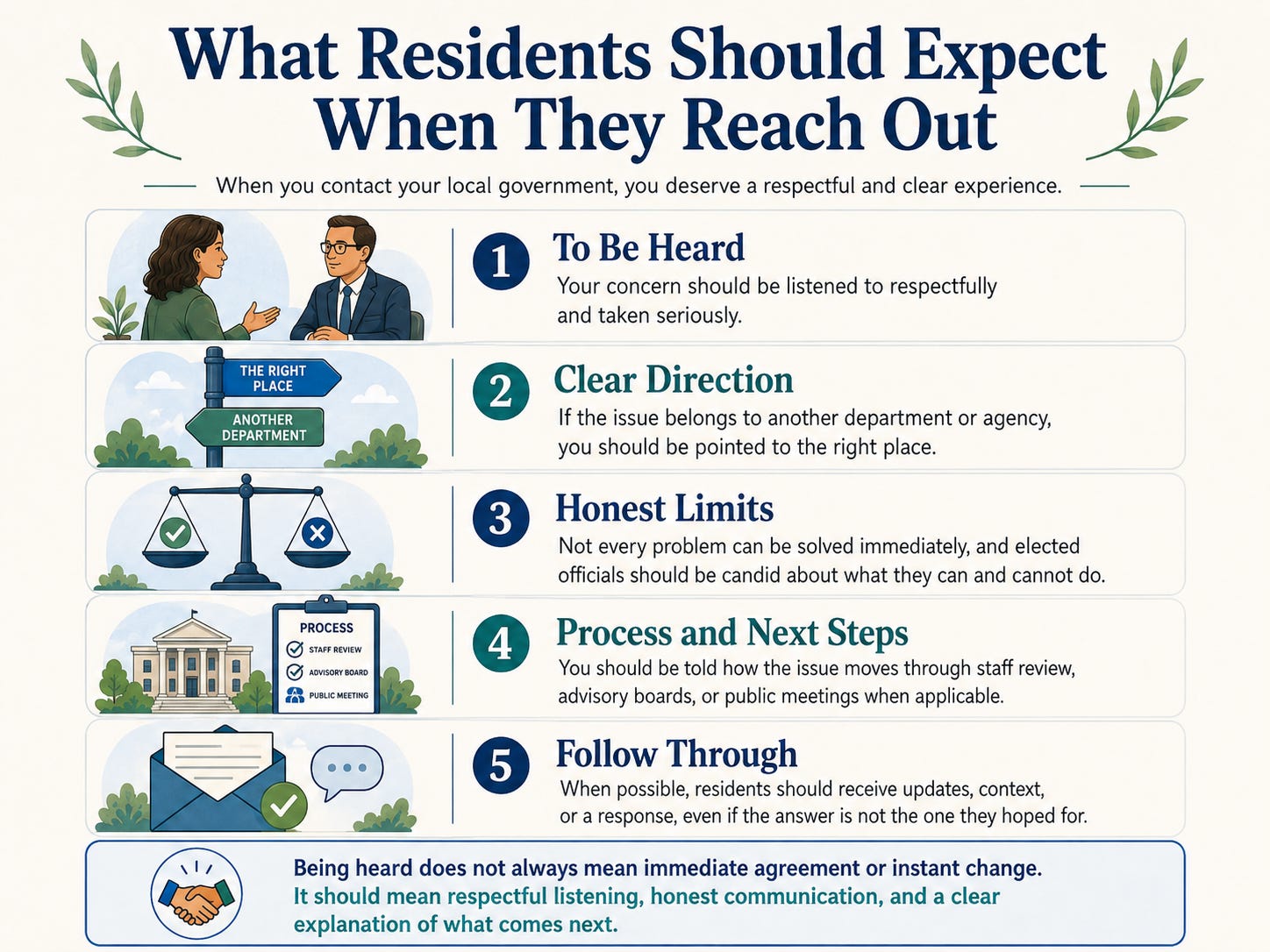
Residents should expect elected officials to treat them respectfully, communicate in understandable language, explain their decisions, and remain open to continued dialogue when disagreement occurs. They should also expect honesty about what an official can do, what falls outside that official’s authority, and when no immediate solution is available.
Listening should not include promises that cannot be kept. It is more respectful to explain the limits of an office than to suggest that a concern can be resolved when the official has neither the authority nor the ability to produce that result.
Residents should also expect elected officials to say when they do not know something, when additional information is needed, when government made a mistake, or when public input changed how an issue was understood.
A vote tally is not a complete explanation. Residents should be able to understand what problem a decision was intended to address, what alternatives were considered, what constraints applied, and why an elected official supported or opposed the final action.
Continuing the Conversation
No resident should be expected to participate in every meeting, follow every agenda, or communicate about every issue. Civic participation can take a form that is realistic for the individual and connected to the subjects they care about.
That may mean sending an occasional email, speaking during public comment on a specific proposal, writing a letter to the editor, joining a community organization, applying for an advisory board, volunteering, attending an open house, or listening to neighbors with different experiences.
A previous frustrating experience does not have to end the conversation. Residents can follow up, ask what happens next, request clarification about who has authority, provide additional information, or participate when the issue reaches another stage of review.
Elected officials have a corresponding responsibility to make communication respectful, understandable, and honest. They should not dismiss frustration, offer false promises, or rely on procedural language without explaining what it means for the person seeking help.
Disagreement will always be part of representative government. The goal is not to eliminate disagreement or guarantee that every participant receives the outcome they requested. The goal should be a local government in which residents can see how to participate, understand who has authority, receive honest explanations, and continue the conversation after a comment, email, meeting, or vote.
Public trust is not created by asking residents to assume government listened. It grows when the public can see that concerns were taken seriously, decisions were explained, limits were acknowledged, and communication remained open even when people reached different conclusions.
I would love to hear from you! Please feel free to reach out to me at jhamilton@cityofpa.us or come up and talk with me if you see me around town.