
From Planning to Public Process
A recap of the June 16, 2026 Port Angeles City Council meeting

Standard Disclaimer: This newsletter is written in my capacity as an individual Port Angeles City Councilmember (Position 7). It represents my personal views, research, and understanding of municipal issues. It is not an official statement on behalf of the Port Angeles City Council or the City of Port Angeles. In compliance with the Washington State Open Public Meetings Act (OPMA), comments are disabled to ensure that council deliberation and public business remain within noticed public meetings. Please be advised that any communication sent to me regarding City business, including emails to jhamilton@cityofpa.us, may be considered a public record subject to disclosure under the Washington State Public Records Act (PRA).
The June 16 City Council meeting was another step in a sequence of meetings focused on infrastructure, public safety, housing, ratepayer protection, environmental stewardship, and long-term fiscal planning.
The Council adopted the 2027–2032 Capital Facilities Plan and Transportation Improvement Plan. We opened and continued a public hearing on the proposed HB 2015 criminal justice sales tax. We approved several consent agenda items, including a community-funded tennis court improvement agreement, tree trimming final acceptance, and closeout of an on-call water main repair contract. We also considered a late item related to the Western Port Angeles Harbor cleanup process and approved a design services agreement for Project 935, the City’s housing pipeline pilot project.
This meeting connected directly to the series of articles I have been writing over the last several weeks:
In “Reading the Blueprint in Public,” I wrote about the May 26 Council work session where the Council first reviewed the preliminary 2027–2032 CFP/TIP in detail.
In my June 2 recap, “From Blueprint to Public Record,” I wrote about the first CFP/TIP public hearing, public testimony on Ediz Hook, the pavement management presentation, and the broader infrastructure maintenance challenge facing Port Angeles.
In “How Port Angeles Decides What Gets Built,” I stepped back from a single meeting and explained how the City uses the CFP/TIP, grants, unfunded project listings, staff capacity, public hearings, and Council decision-making to move from ideas to public infrastructure.
In “Keeping the Lights On and the Rates Stable,” I wrote about the June 9 Utility Advisory Committee meeting and how UAC reviewed the Electric Utility 2026 Power Resource Plan and the utility-related portions of the CFP/TIP before making advisory recommendations to the Council.
The June 16 meeting brought that process to the next stage.
It was not just a meeting about adopting a planning document or holding a first hearing on a tax ordinance. It was a meeting about how Port Angeles connects public input, staff analysis, adopted plans, advisory committee review, grant opportunities, infrastructure needs, and final Council action.
Juneteenth Proclamation
The only ceremonial item at the June 16 meeting was the Juneteenth Proclamation.
Mayor Dexter read the proclamation recognizing June 19 as Juneteenth. The proclamation described Juneteenth as Freedom Day, Emancipation Day, or Jubilee Day, commemorating the day in 1865 when news of the Emancipation Proclamation finally reached enslaved people in Texas.
The proclamation also recognized the importance of education, reflection, and action in confronting racism, inequity, and institutional barriers. It affirmed the City’s commitment to equity, inclusion, and a respectful community.
I appreciated that the meeting began with that reflection.
Juneteenth is not only a historical marker. It is also a reminder that public institutions have a responsibility to examine whether their policies, systems, and practices serve people fairly. For local government, that means being transparent, listening carefully, and continuing to work toward a city where residents, workers, families, and visitors are treated with dignity and respect.
Public Comment Themes
Public comment at this meeting reflected several community priorities.
During the first public comment period, several speakers spoke in support of the Peninsula Tennis Club’s work to fund improvements at the Erickson Playfield tennis courts. The comments described the condition of the courts, the long history of the club’s partnership with the City, the importance of public recreational facilities, and the major community fundraising effort that made the project possible.
The Council later approved the Facility Improvement Agreement on the consent agenda. The agreement allows the Peninsula Tennis Club to support resurfacing and lighting improvements at the courts, funded by donations raised by the club. This is a good example of a community partnership that improves a public asset without using General Fund dollars.
Public comment during the HB 2015 criminal justice sales tax public hearing focused on public safety, police staffing, accountability, substance use, harm reduction concerns, and the relationship between public safety services and community trust. One speaker supported the tax while raising concerns about public health and enforcement consistency. Another speaker supported the tax as a practical way to help fund additional officers while leveraging state grant funding.
Those comments fit within a broader public conversation that has continued across several recent Council meetings.
Residents have raised concerns about homelessness, encampments, public safety, shelter options, transitional housing, sanitation, downtown conditions, the impacts on businesses, and the need for accountability. Other residents have emphasized compassion, housing access, services, health care, bathrooms, trash disposal, and the need for realistic shelter pathways.
Those perspectives are not always easy to reconcile.
Some residents are asking the City to move faster on enforcement and public safety. Others are asking the City to move faster on shelter, services, and housing. Business owners are asking for safer and more predictable conditions. Service providers and advocates are asking that the community not lose sight of the human needs behind homelessness and addiction.
A responsible Council has to hear those concerns together.
Public safety, housing, shelter, economic development, public health, and community trust are connected. The City cannot solve every regional challenge alone, but it does have responsibilities within its own authority: budgeting, land use, public safety capacity, public infrastructure, parks, streets, public facilities, coordination with partner governments, and transparent public process.
2027–2032 Capital Facilities Plan / Transportation Improvement Plan
One of the most important actions of the evening was the adoption of the 2027–2032 Capital Facilities Plan and Transportation Improvement Plan.
The CFP/TIP is the City’s long-range capital planning document. It identifies major infrastructure and capital project needs over a six-year planning window. It includes roads, sidewalks, utilities, parks, public safety infrastructure, housing-related projects, public facilities, stormwater, water, wastewater, electric, solid waste, fleet, technology, and transportation projects.
The Transportation Improvement Plan portion also meets state requirements for the City’s six-year transportation planning process.
In plain language, the CFP/TIP helps answer several questions:
What infrastructure does the City know it needs?
Which projects are funded?
Which projects are unfunded?
Which projects may depend on grants or outside partnerships?
Which projects support adopted plans?
Which projects help maintain existing assets?
Which projects support housing, public safety, economic development, environmental stewardship, or transportation connectivity?
Which projects need to be tracked publicly even if the money is not yet available?
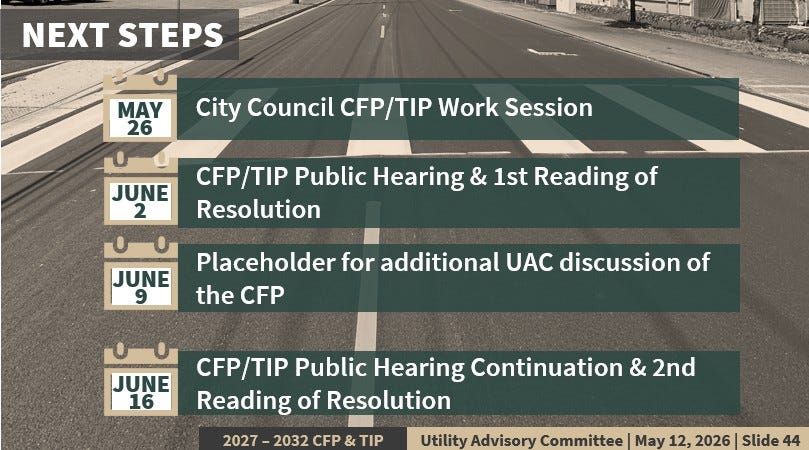
This was the second reading and adoption of the CFP/TIP resolution. The plan had already moved through several public steps: staff development, website publication, the May 26 Council work session, the June 2 public hearing and first reading, June 9 Utility Advisory Committee review, and the June 16 continued public hearing and final Council action.
That sequence is important.
The CFP/TIP did not move in one step. It moved through review, public notice, public hearing, advisory committee recommendation, Council discussion, amendments, and final adoption.
That is how the process should work.
What changed before adoption
Finance Director Sarina Carrizosa explained that there had been updates since the first review.
One update involved the Athletic Field Facility Assessment project, which was added as an unfunded project following Council discussion at the June 2 meeting. This does not fund construction or guarantee a specific facility outcome. It keeps the need visible in the City’s capital planning framework so the City can evaluate conditions, maintenance needs, capital improvements, grant opportunities, lodging tax possibilities, partnerships, and other outside funding sources.
Another update corrected the funding status for the City Hall Server Room HVAC Rooftop Units project. The packet attachment had identified the project as unfunded, but staff clarified that the project is funded in the amount of $55,000 and that the final document would reflect that correction.
The plan also included the title and scope change for TR0919, now School Safety Lighting. That project had previously been tied to a traffic safety camera concept. After public concern and Council discussion, staff narrowed the scope to flashing lights and speed feedback signs in school zones.
That remains a useful example of public process. Concerns were raised. Staff reviewed the project. The scope was clarified. The project remained focused on school safety while removing cameras from the current scope.
Ediz Hook and the final CFP/TIP amendment
The Council also discussed the Ediz Hook boat launch project.
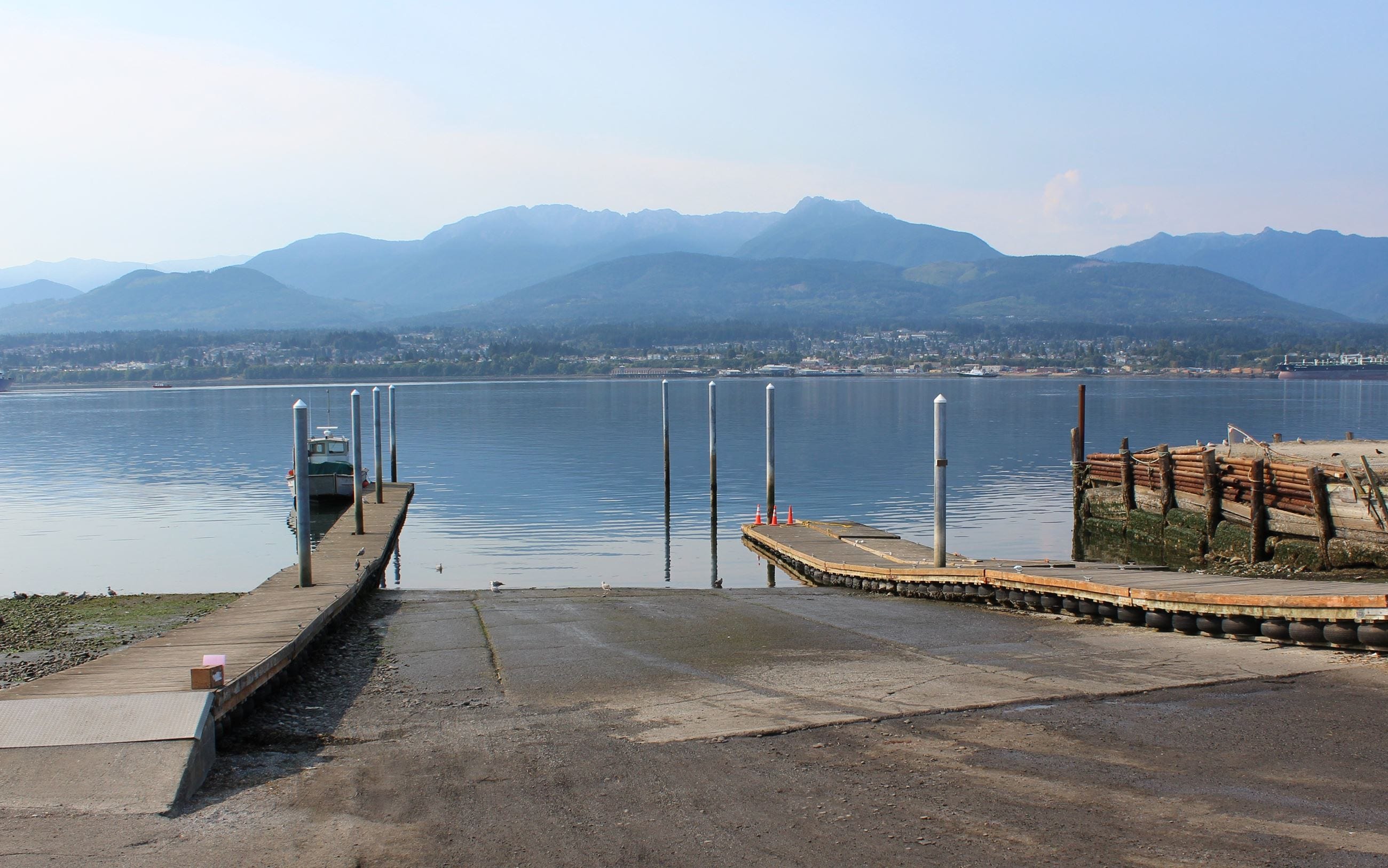
At the June 2 public hearing, residents spoke strongly about the importance of the Ediz Hook boat launch. They discussed marine access, safety, economic activity, tourism, fishing access, and the need to understand the next steps for a compliant replacement.
At the June 16 meeting, the Council considered whether the CFP/TIP should include additional language acknowledging the need to look beyond simply replacing floating docks. Mayor Dexter proposed adding a Phase Two to the Ediz Hook boat launch project to identify alternatives to ensure floating docks are protected.
After Council discussion and clarification from staff, the Council unanimously approved the amendment. The Council then unanimously adopted the 2027–2032 CFP/TIP as amended.
This is an important distinction.
The amendment does not select a final design. It does not resolve permitting, cost, FEMA, shoreline, environmental, or long-term maintenance questions. It does not pre-commit the City to a particular location or project outcome.
It keeps the issue in the planning framework.
That matters for grant readiness, future analysis, and public accountability. If a project or phase is not listed, it can be harder to track, discuss, or connect to future funding opportunities. Listing it allows the City to keep the broader issue visible while staff continue evaluating what is feasible, fundable, permitted, and responsible.
Why unfunded projects stay in the plan
A recurring point in my recent articles is that “unfunded” does not mean “unimportant.”
The CFP/TIP includes projects that are funded, partially funded, grant-dependent, and unfunded. That can be confusing if a reader assumes a listed project is the same thing as approved construction.
It is not.
A project can be listed because the need is real, while still remaining unfunded because no funding source has been identified yet.
A project can be listed to preserve transparency.
A project can be listed so the City can pursue grants.
A project can be listed so staff and Council can keep evaluating it as priorities, costs, public input, and outside funding opportunities change.
A project can be listed because the City needs to track long-term infrastructure needs even when the money is not available today.
That is part of fiscal stewardship. The City should not pretend every need is funded. It also should not hide needs simply because funding is not yet available.
The better approach is to name the need, identify the status, and keep the public process open.
My comments on the CFP/TIP
During the CFP/TIP discussion, I thanked staff for their work and flexibility through the process.
This plan took significant staff time. It required coordination across departments, review by the Utility Advisory Committee, discussion at Council, and updates based on community and Council input.
I also echoed what we discussed at UAC: the utility-related portions of the plan were built in a way that protects ratepayers by not proposing utility rate increases above what is already adopted in the plan.
That does not mean there are no future cost risks.
Infrastructure costs can rise. Emergencies can happen. Grants can change. Federal or state requirements can shift. Staff capacity can affect timelines. Future Councils will still have to make decisions.
But for this planning cycle, staff presented a CFP/TIP that maintains the existing adopted rate path, avoids new debt for the 2027–2032 planning cycle, and keeps long-term needs visible.
That is the kind of disciplined planning residents should expect from the City.
HB 2015 Criminal Justice Sales Tax Public Hearing
The second public hearing of the evening involved the proposed HB 2015 criminal justice sales tax ordinance.
This item followed up on prior Council discussion from the April 28 work session and May 5 Council meeting. On May 5, the Council accepted grant funding connected to HB 2015 to support four new police officer positions and directed staff to bring forward the documents and public hearing process for a councilmanic one-tenth of one percent sales tax for criminal justice purposes.
At the June 16 meeting, Finance Director Sarina Carrizosa presented the item, the Mayor opened the public hearing, public testimony was received, and the Council conducted the first reading of the ordinance. The public hearing was continued to the July 7 Council meeting.
That means the process is not complete yet.
Council has not taken final action on the ordinance. Additional public process remains.
What HB 2015 allows
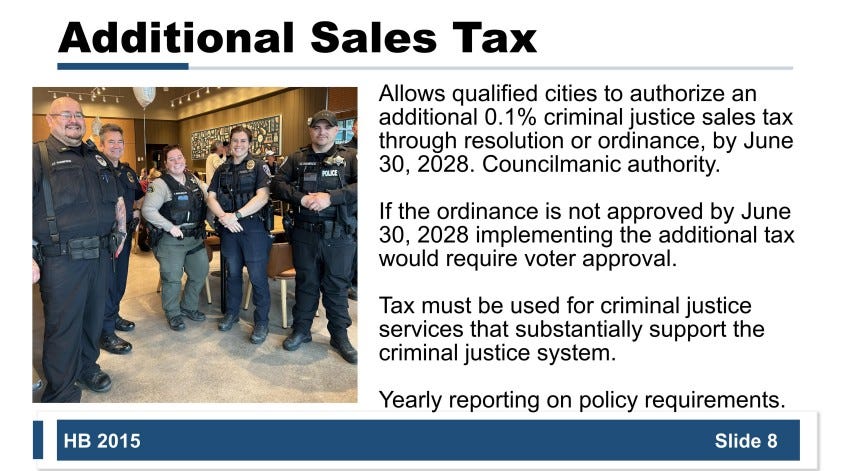
HB 2015 created a local revenue option for qualifying cities and counties to impose an additional one-tenth of one percent sales and use tax for criminal justice purposes.
The City was deemed eligible because of the related grant award through the Criminal Justice Training Commission. The grant is approximately $785,680 over two years and covers 75 percent of the personnel costs for four new police officers.
The proposed sales tax would help support the remaining local costs connected to those positions, including the remaining 25 percent of personnel costs and related outfitting needs such as gear, vehicles, supplies, and training.
The revenue must be used for criminal justice services that substantially support the criminal justice system. The legislation also includes yearly reporting requirements.
That accountability is important. A dedicated revenue source should have clear public expectations, clear legal restrictions, and clear reporting.
Why I support this approach
I support this sales tax.
Public safety is a core City service. Police staffing affects response capacity, proactive policing, officer workload, public trust, downtown conditions, neighborhood safety, business confidence, and the City’s ability to respond to complex calls.
The question before the Council is not whether public safety has a cost. It does.
The question is how to fund added capacity responsibly.
In this case, I strongly prefer the proposed sales tax approach over raising property taxes to fund the same public safety capacity.
A property tax increase would fall directly on property owners within the City. A sales tax spreads the cost more broadly across residents, visitors, and commercial activity in Port Angeles. Visitors use City streets, parks, emergency services, public spaces, and business districts. A sales tax means they contribute to the public safety system that supports those places.
Staff estimated that the proposed one-tenth of one percent sales tax would generate approximately $510,000 in 2027. Staff also estimated that the average annual cost to a household would be about $20.60 under the sales tax, compared with about $49.60 if the same amount were raised through a property tax levy.
That is a meaningful difference.
It is also a way to leverage state funding. The state grant covers a substantial portion of the first two years of personnel costs for four officers. The local revenue source helps the City sustain the local portion and plan for the transition after temporary grant funding.
I do not view this as an easy decision, because no tax increase should be treated casually.
But I do view it as a responsible public safety funding strategy.
It is limited to criminal justice purposes. It is tied to a specific staffing need. It is connected to state grant funding. It spreads the cost across a broader base than property taxes. It includes reporting requirements. And it keeps the discussion in public, through a public hearing and ordinance process.
Public process on the sales tax continues
The Council opened the public hearing on June 16 and continued the item to July 7.
That means residents still have an opportunity to follow the process and provide input before final action.
The earliest collection date discussed by staff would be January 1, 2027, provided the ordinance is approved and the required notice is submitted to the Department of Revenue within the required timeline.
For residents, the key points are these:
The proposal is one-tenth of one percent.
The revenue is restricted to criminal justice purposes.
The City’s eligibility is connected to the HB 2015 grant award.
The grant supports four additional police officer positions.
The sales tax would help fund the local share and related officer costs.
Annual reporting requirements apply.
Council has not completed final action yet.
The public hearing continues to July 7.
That is how this kind of decision should move: staff presentation, public hearing, Council questions, first reading, continued public process, and final Council consideration at a future meeting.
Other Council Business
Several other items were approved or discussed during the meeting.
Consent agenda
The Council unanimously approved the consent agenda.
The consent agenda included approval of prior meeting minutes, an expenditure report totaling $1,694,010.20, the Facility Improvement Agreement with the Peninsula Tennis Club, final acceptance of the Tree Trimming Project CON-2025-04, and termination acceptance for the On-Call Water Main Repair Contract SVC-2022-65.
The tennis court agreement stood out because of the community partnership behind it. Peninsula Tennis Club members raised approximately $170,000 to support resurfacing and lighting improvements at the Erickson Playfield tennis courts. Public comments before the consent agenda emphasized the importance of those courts for public recreation, youth access, high school use, and community wellness.
This is the kind of partnership that fits well with the City’s strategic goals around community health, wellness, and resilience. It improves a City asset, supports recreation, and reflects community initiative.
The tree trimming final acceptance also connects to infrastructure maintenance. Tree trimming near power lines is not always a visible public priority until storms, outages, or safety hazards occur. Regular vegetation management helps protect electric reliability, reduce outage risk, and maintain safe infrastructure.
The water main repair contract termination reflected another basic infrastructure reality: emergency water repairs require both planning and contractor capacity. Some City water mains are in difficult terrain, including steep ravines, creek crossings, and deep locations. When contractors close or contracts end, the City has to adapt while maintaining emergency response readiness.
Western Port Angeles Harbor cleanup late item
The Council also approved a late item related to the Western Port Angeles Harbor cleanup process.
Staff explained that the City is one of several potentially liable parties (PLP) involved in a long-running harbor cleanup process with the Department of Ecology. The item authorized an additional $50,000 payment to the potentially liable parties group account to support continued work by Tetra Tech on remedial design work.
I asked a clarifying question about whether the City anticipates reimbursement through insurance or Department of Ecology grant funding. Staff confirmed that insurance is expected to cover the majority of costs and that the City is also working on Department of Ecology grant funding for costs not covered by insurance.
This is another example of ecological stewardship intersecting with fiscal stewardship.
Harbor cleanup work is legally complex, environmentally important, and financially significant. When the City participates in that work, residents should be able to understand both the environmental purpose and the funding strategy.
Project 935: Housing Pipeline Pilot Project
The Council also approved the Project 935 Design Services Phase Agreement with Dialog for the Housing Pipeline Pilot Project.
Project 935 is the City’s multifamily housing pipeline pilot project at 935 West 10th Street. It is connected to the City’s Housing Action Plan and Strategic Plan housing goals. The project is designed to address the shortage of multifamily housing, expand affordable and attainable housing opportunities, support efficient land use, and demonstrate higher-density mixed-use development in a commercially zoned area.
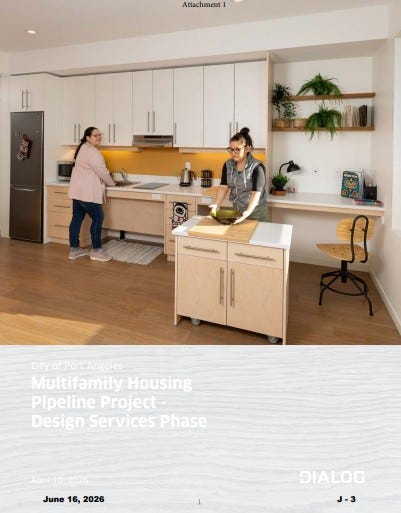
The City previously accepted a $1,988,500 Department of Commerce housing grant to support the project. The June 16 action authorized the City Manager to approve a professional services agreement with Dialog for design services in an amount not to exceed $1,283,641.
This is not construction approval. It is a design services phase agreement.
That distinction is important.
Housing policy often sounds abstract. Project 935 is one way the City is trying to move from policy into implementation. It addresses site readiness, early design costs, predevelopment barriers, and replicable plans that may help future housing projects. The goal is not only one site. The goal is to learn from this pilot and improve the City’s ability to support more housing over time.
This connects directly to the Housing Action Plan, the Comprehensive Plan, and the Council’s housing priorities.
Port Angeles needs more housing choices. That includes workforce housing, multifamily housing, affordable housing, attainable housing, and housing types that fit within existing infrastructure and transportation networks. Project 935 is one piece of that larger work.
Recap of my Council report
During Council reports, I kept my comments brief.
I mentioned the June 9 Utility Advisory Committee meeting, which I had already written about in my recap, “Keeping the Lights On and the Rates Stable.”
I also attended the Port Angeles High School graduation on June 12. It was a good day to celebrate students and their families. I noted how impressive it is to see students earn honors, academic recognition, and college credit while completing high school.
I took a moment to thank Port Angeles High School Principal Jeff Lunt for his service to the school district and the community. His work with students, staff, athletics, and school culture has been meaningful, and I wished him well as he moves on to his next professional role.
I also attended Pride at the Pier on Sunday, June 14 and read the City’s Pride Month proclamation because Mayor Dexter was not available. I appreciated seeing the vendors, community members, and cultural expression at the event. It was well organized and reflected the importance of creating public spaces where residents can gather, celebrate, and be seen.
Finally, I attended the Clallam County Marine Resources Committee meeting as the City’s alternate representative on June 15. The main presentation was giveb by Suzanna Shull and focused on centralized data collection through SoundIQ and how that information can support Marine Resources Committees across the region. The discussion included how data can help track and understand marine projects, ecological conditions, forage fish, and other marine resource work.
That kind of data matters for long-term environmental stewardship. Good policy depends on good information.
What Comes Next
Several items from this meeting will continue through future public process.
The HB 2015 criminal justice sales tax public hearing continues to the July 7 Council meeting. Residents who want to comment on the proposed one-tenth of one percent sales tax for criminal justice purposes will still have an opportunity to participate before final Council action.
The adopted 2027–2032 CFP/TIP will become part of the City’s capital planning framework. Staff will continue using it to guide project planning, budget development, grant readiness, and future updates. Because the CFP/TIP is updated annually, residents will continue to see changes as projects move forward, funding sources shift, and new needs emerge.
The Ediz Hook boat launch project now includes the added Phase Two language to identify alternatives to ensure floating docks are protected. That work will still require future analysis, public process, funding evaluation, environmental review, and Council consideration where applicable.
Project 935 will move into the design services phase. Residents should watch for future updates on concept design, site planning, community engagement, and how this pilot project may inform future housing work.
The criminal justice sales tax discussion will remain tied to broader questions about public safety capacity, fiscal responsibility, grant funding, and how the City sustains core services.
The larger theme is the same one I have been writing about throughout this series: city decisions do not happen in isolation.
Infrastructure planning connects to housing.
Housing connects to utilities.
Public safety connects to staffing and sustainable funding.
Environmental stewardship connects to long-term liability and grant strategy.
Public trust depends on clear records, public hearings, transparent explanations, and disciplined decision-making.
I will continue using these recaps to explain not only what the Council did, but why the process works the way it does and what residents should watch next.
Full meeting recording available below:
Next Council Meeting: Tuesday, June 23, 2026 at 5:00pm - Joint session with the Board of Clallam County Commissioners