
Keeping Essential Services Moving
A recap of the June 23 joint City Council and Clallam County Board of Commissioners meeting

Standard Disclaimer: This newsletter is written in my capacity as an individual Port Angeles City Councilmember, Position 7. It represents my personal views, research, and understanding of municipal issues. It is not an official statement on behalf of the Port Angeles City Council or the City of Port Angeles. In compliance with the Washington State Open Public Meetings Act, comments are disabled to ensure that Council deliberation and public business remain within noticed public meetings. Please be advised that any communication sent to me regarding City business, including emails to jhamilton@cityofpa.us, may be considered a public record subject to disclosure under the Washington State Public Records Act.
The Port Angeles City Council and the Clallam County Board of Commissioners met in a joint special meeting on June 23 to discuss criminal justice services.
It was a short meeting. It was also an important one.
When people think about public safety, they often think first about police officers, emergency calls, patrols, or visible issues in the community. Those are important. But public safety is also supported by less visible systems: prosecution, public defense, courts, jail services, contracts, budgets, and agreements between governments.
Those pieces may not make for the most dramatic public meeting, but they affect whether the system works.
As a parent, I want my kids to grow up in a community where people can feel safe.
As a teacher, I know young people and families need stability, accountability, and support.
As a community member, I want local government to solve problems without turning every disagreement into a fight.
And as a City Councilmember, I want us to make decisions in public, protect essential services, and take enough time to get the details right.
That is what this meeting was about.
The City and County are working through new agreements for criminal justice services. Those agreements were not ready for final approval on June 23, so the Council took action to preserve continuity while the work continues.
In plain language: the services continue, and the City and County are still working toward updated agreements.
How this meeting fits into the bigger picture
This meeting connects to the public safety and fiscal responsibility conversations I have been writing about throughout June.
At the June 16 City Council meeting, Council opened and continued the public hearing on the proposed HB 2015 criminal justice sales tax. That proposal is about funding additional local public safety capacity, including the local cost of four new police officer positions connected to state grant funding.
The June 23 joint meeting was about another part of the same system: what happens after law enforcement contact occurs.
Police staffing matters.
Prosecution matters.
Public defense matters.
Courts matter.
Jail services matter.
And the agreements behind those services matter.
Residents may not follow every contract detail, and I understand that. Most people are busy working, raising families, paying bills, caring for loved ones, and trying to keep up with daily life. They should not have to become experts in interlocal agreements to understand what their local government is doing.
My goal with these recaps is to make the process clearer.
The June 23 meeting was not about every public safety issue facing Port Angeles. It was about keeping essential criminal justice services moving while the City and County complete the next round of agreements.
A narrow agenda
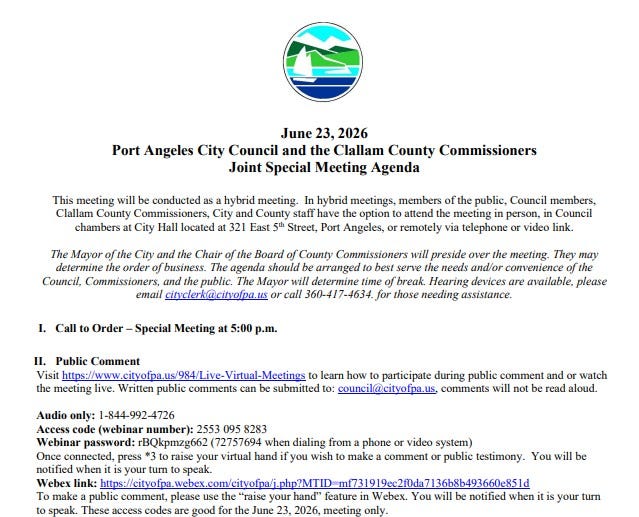
The agenda for this meeting was narrow.
The City Council and County Commissioners met to discuss prosecution services, public defense services, and the extension of the existing criminal justice services agreement.
There was no public comment during the meeting.
City Manager Nathan West explained that the City and County had hoped to be further along by the time of the joint session. The goal had been to bring forward agreements for prosecution and public defense services.
Those agreements were close, but they were not ready for final approval.
Additional legal review was still needed by both the City and the County. Staff also explained that the City and County were generally on the same page on the dollar amounts and generally aligned on the methodology, but some language still needed work.
That distinction is important.
This was not presented as a breakdown. It was presented as a situation where both governments needed more time to make sure the agreements were right before approving them.
I think that is the responsible approach.
It is frustrating when timelines stretch. I know residents want these issues resolved. I do too. But it is better to take a little more time and approve agreements that are clear, workable, and legally sound than to rush something because a deadline is uncomfortable.
Council unanimously voted to table the prosecution and public defense agreements to a future Council meeting.
What services are we talking about?
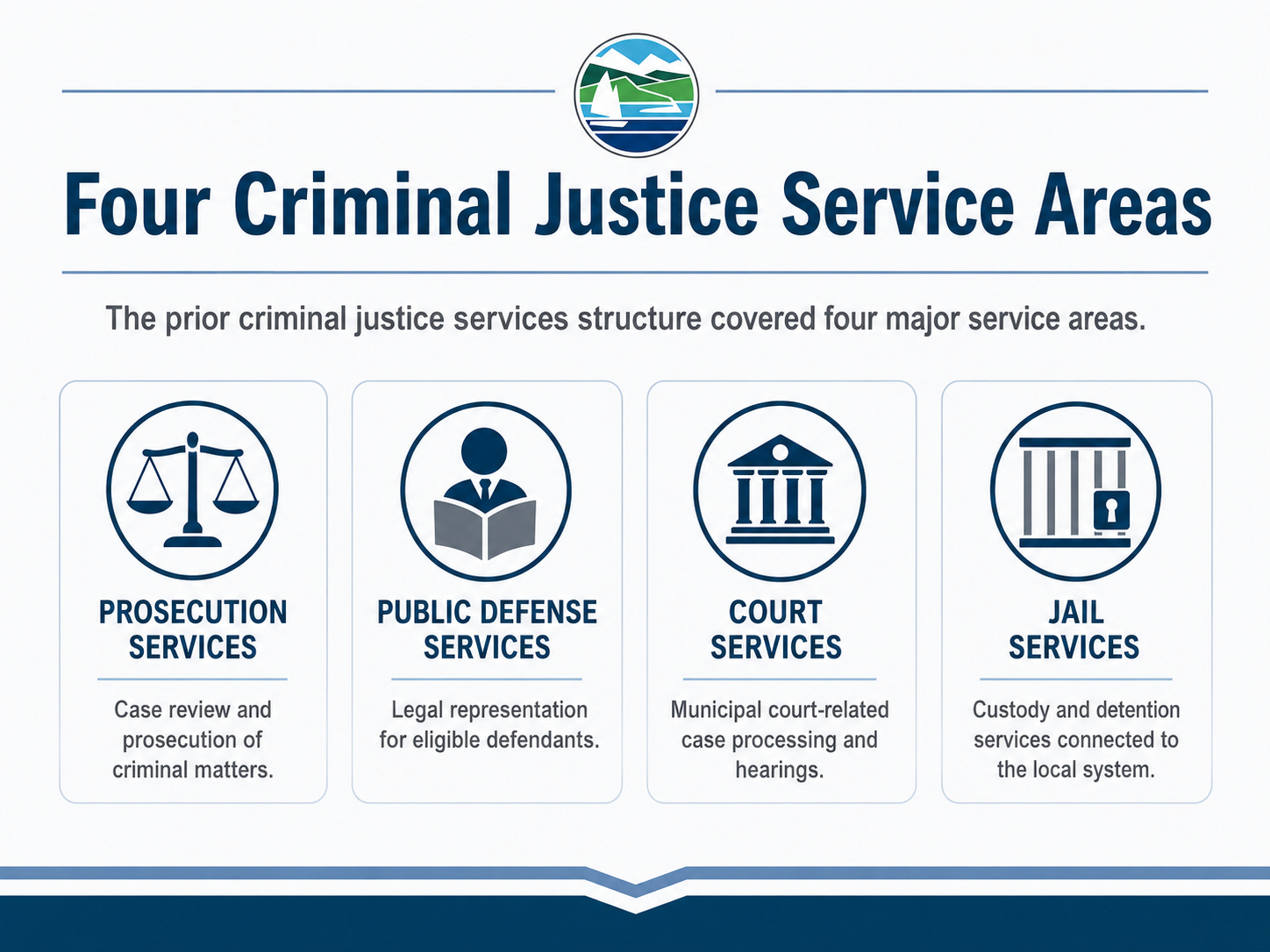
The previous criminal justice services structure covered four major areas: prosecution, public defense, court services, and jail services.
These services are connected, but they are not the same.
Prosecution is about reviewing and handling criminal cases.
Public defense is about making sure eligible defendants have legal representation.
Court services are about the legal process, hearings, and case management.
Jail services involve custody and detention.
Each one carries different costs, staffing needs, legal responsibilities, and operational realities.
That is one reason the City and County are now working toward separate agreements instead of one large umbrella agreement.
From a public perspective, this may sound technical. But the basic idea is simple: clearer agreements should help everyone better understand what is being provided, how costs are calculated, and who is responsible for which part of the system.
Clear agreements help residents understand what each government is responsible for, how costs are shared, and how essential services will continue. That kind of clarity builds accountability and public trust.
When local governments share responsibilities, the public deserves clarity. Residents should not have to guess whether the City or County is responsible for a service, how much the service costs, or whether the service will continue.
Why services continue while negotiations continue
One point from the meeting is worth saying clearly: prosecution and public defense services continue during this period.
Deputy Mayor Navarra Carr made that point during the meeting, and I agree with it.
Tabling the agreements does not mean these services stop. It does not mean they are less important. It means the final agreements need more review before approval.
That is an important message for the public.
Public safety requires accountability, but it also requires due process. It requires prosecution, but it also requires public defense. It requires officers, but it also requires courts. It requires laws, but it also requires constitutional protections.
Those are not competing values. They are part of the same system.
A healthy community needs both safety and fairness. Local government has a responsibility to support both.
Extending the current agreement
The most important action of the evening was about extending the existing criminal justice services agreement.
The current interim agreement was approaching a June 30 expiration date. Since the City Council does not meet again before that date, the City needed to act on June 23 to avoid uncertainty.
Staff presented a preferred path and a backup path.
The preferred path is called Amendment Two. It sets a target date of September 30, 2026, for completing the broader criminal justice services contracts and extends the agreement to December 1, 2026, if more time is needed.
The backup path is a notice letter. That letter protects the City’s ability to trigger a 120-day extension if the County does not approve Amendment Two before June 30.
In everyday terms, Council approved a plan that says:
We want the City and County to approve the extension amendment.
But if that does not happen before the deadline, the City still has a way to protect continuity of service.
That is not flashy, but it is important.
It is the kind of practical step local government needs to take before a deadline arrives, not after.
Council unanimously approved the motion.
Why the dates matter?
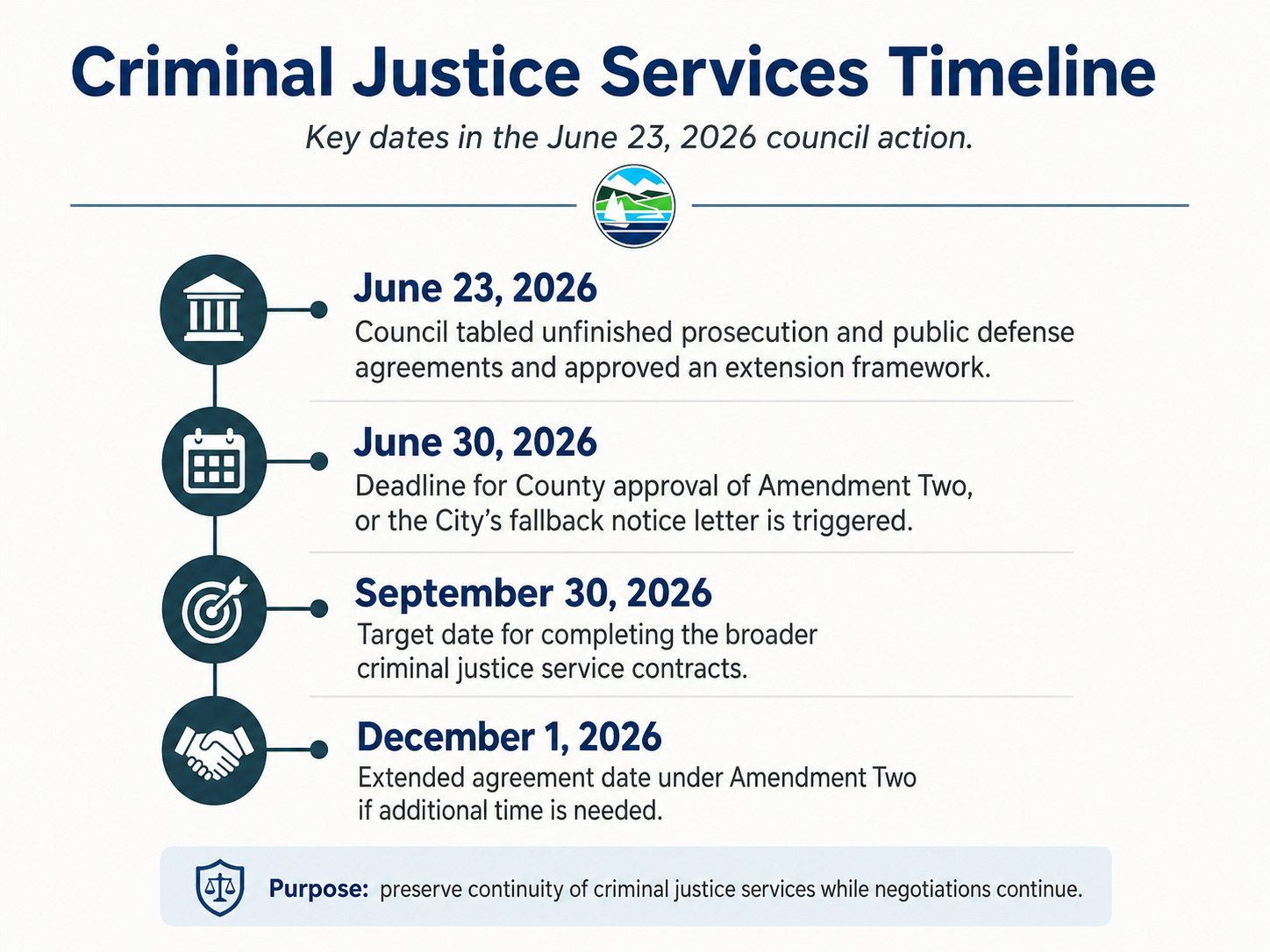
There are three dates residents should understand.
The first is June 30, 2026. That was the immediate deadline. The City needed to act before then to avoid letting the existing agreement expire without an extension path.
The second is September 30, 2026. That is the target date for completing the broader criminal justice services contracts.
The third is December 1, 2026. That is the extended agreement date under Amendment Two if additional time is needed.
Mayor Dexter explained that September 30 is not a date anyone is trying to stretch toward. It is a practical target because both the City and County also need to begin building their 2027 budgets. These agreements affect those budgets.
That is one of the things I have learned quickly on Council: timelines matter because budgets matter.
When a contract affects public safety services, staffing, and future costs, the City has to understand the numbers before making budget decisions. The same is true for the County.
City and County responsibilities overlap
This meeting also showed how City and County responsibilities overlap.
Residents experience public safety as one system. If something happens, people want help. They want someone to respond. They want cases handled. They want rights protected. They want fair outcomes. They want safety and accountability.
But behind the scenes, different parts of that system are handled by different governments and different offices.
The City provides municipal services, including local police services and City budgeting.
The County provides countywide and regional services, including many parts of the criminal justice system.
Separately elected County officials also have their own responsibilities. The Sheriff, Prosecuting Attorney, courts, and public defense system each have roles that are not simply controlled by the Board of County Commissioners or the City Council.
That can be complicated.
It can also be frustrating for the public.
But it is one reason these agreements need to be handled carefully. The City cannot simply direct County operations. The County cannot ignore the City’s need for clear costs and reliable services. Both governments have to work through the details.
That is what residents should expect: not finger-pointing, but careful work.
My perspective
I did not speak during the June 23 meeting, but I supported the action taken.
The City needed to preserve continuity of criminal justice services. The prosecution and public defense agreements were close, but not ready. The County needed time for additional review. The City needed to act before the June 30 deadline.
The action we took was practical.
It tabled the unfinished agreements to a future meeting.
It approved the preferred extension path.
It approved a backup notice letter if the County does not approve the amendment before the deadline.
It authorized the Mayor and City Manager to carry out the documents needed to make the action effective.
That is responsible governance.
It keeps services moving while giving both governments time to complete the work correctly.
As a councilmember, I want agreements that are fair, clear, and fiscally responsible.
As a community member, I want City and County leaders to work together respectfully.
As a parent and teacher, I want the adults in the room to keep essential services functioning while they work through difficult details.
That is what this meeting accomplished.
What Comes Next
The prosecution and public defense agreements will come back to a future Council meeting once the remaining review is complete.
The County is expected to continue its own process, including review by the Board of Commissioners and consultation with the relevant separately elected officials.
If the County approves Amendment Two on or before June 30, the agreement extension will move forward under that amendment.
If the County does not approve Amendment Two before June 30, the City’s notice letter is designed to preserve the City’s extension rights under the existing agreement.
The target date for completing the broader criminal justice service contracts is September 30, 2026.
The extended agreement date under Amendment Two is December 1, 2026.
Residents should continue watching this issue because it affects core public safety services, the City budget, County services, and the long-term relationship between the City and County.
The larger theme is simple: public safety depends on more than one meeting, one vote, or one agency.
It depends on people doing the work, contracts being clear, budgets being honest, and governments cooperating even when the issues are difficult.
The June 23 meeting was a short meeting.
But it was a necessary one.
Full meeting recording available below