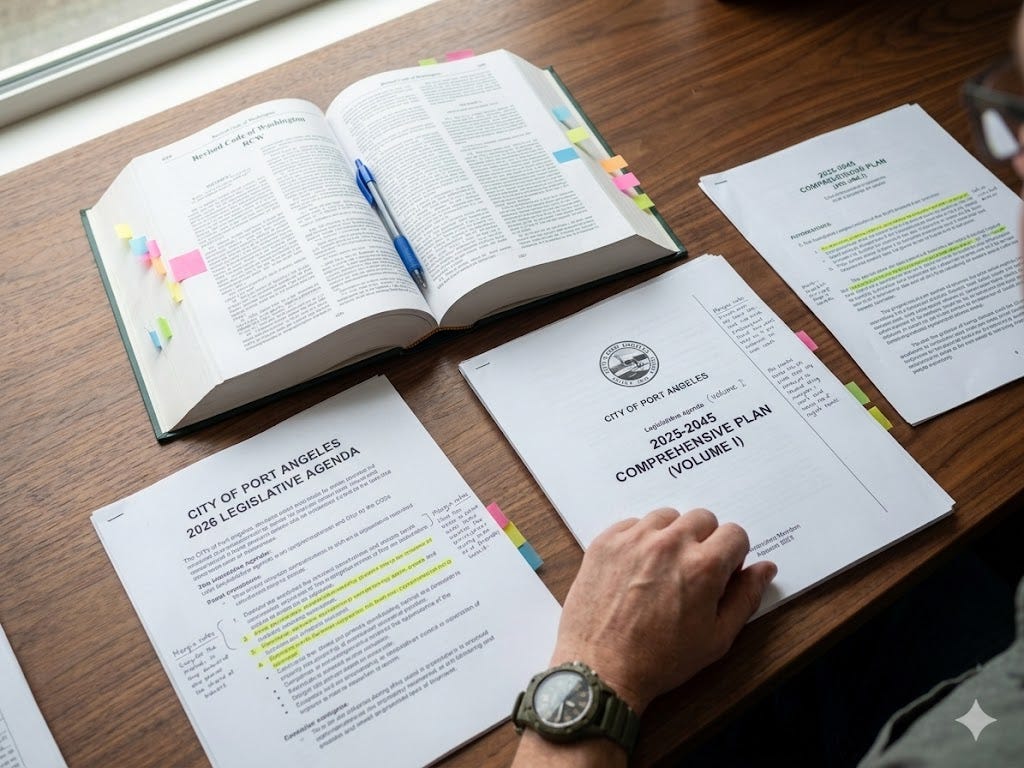
The Intergovernmental Nexus: A Deep Dive into Jurisdictional Architecture
Mapping the Legal, Fiscal, and Operational Boundaries of Port Angeles.

Standard Disclaimer: This newsletter is written in my capacity as an individual Port Angeles City Councilmember (Position 7). It represents my personal views, research, and understanding of municipal issues. It is not an official statement on behalf of the Port Angeles City Council or the City of Port Angeles. In compliance with the Washington State Open Public Meetings Act (OPMA), comments are disabled to ensure that council deliberation and public business remain within noticed public meetings. Please be advised that any communication sent to me regarding City business, including emails to jhamilton@cityofpa.us, may be considered a public record subject to disclosure under the Washington State Public Records Act (PRA).
The Silo Fallacy and the Reality of Distributed Power
In my March 21 essay, Housing, Homelessness, and Economic Development Are the Same Conversation, I argued that our community challenges are a single interconnected civic challenge. However, a significant gap exists between recognizing a problem and having the legal authority to solve it. While the problems are integrated, the tools to solve them are legally fragmented by the Washington State Constitution and the Revised Code of Washington (RCW).
When residents ask why the City does not just fix a specific issue like mental health crisis response or the pace of affordable housing development, they are often unaware that the authority to act may fall under the exclusive jurisdiction of the County, a special purpose district, or the State. This is not a matter of passing the buck or bureaucratic stalling; it is a matter of staying within the law to avoid litigation. If a city acts outside its Police Power authority, it risks costly lawsuits that drain the very resources needed for the solution. This deep dive is meant to map those boundaries so we can focus our upcoming April 7 deliberations on the levers we actually control.
The City Police Power vs. The County Social Mandate
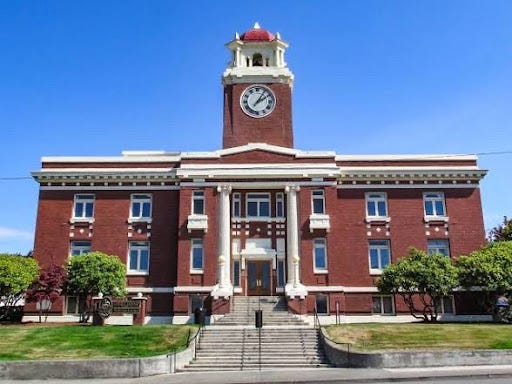
To understand why the City cannot act alone, we must first look at how the State divides regulatory power from service delivery. Port Angeles is a Code City, which grants us the broadest powers of self-governance available under RCW 35A.11.020. This Police Power is the authority to adopt regulations for the health, safety, and welfare of our residents. However, a critical distinction exists between the authority to regulate a behavior and the mandate to provide a service.
The Behavioral Health and Social Service Gap
By state design, Clallam County is the lead agency for human services and public health. This is not a choice made by the City; it is a structural reality of Washington’s safety net architecture. While the City experiences the daily symptoms of the mental health and substance use crisis on our streets, the actual machinery to treat those symptoms — the clinicians, the crisis stabilization beds, and the case management systems — is legally and fiscally managed at the County level.
This includes the administration of the 1/10th of 1% Mental Health Tax. This revenue stream is a countywide tax specifically intended to fund chemical dependency or mental health treatment services. Because the City has no equivalent tax authority or a municipal health department, we lack the standing to receive many of the state and federal grants that fund these services.
As noted in the MRSC City-County Service Coordination Guide, when a city attempts to build its own social service wing from scratch, it often creates a fiscal island. Without the County’s scale or legal mandate, the City would be forced to use General Fund dollars — which are meant for police, fire, and parks — to fund services that residents are already paying for through their County taxes. This creates a technical and moral bottleneck: the City can pass ordinances regarding where people can sleep or sit, but only the County and its providers have the clinical keys to unlock the exits from those situations.
The Enterprise Fund Barrier and Fiduciary Duty
This jurisdictional split is reinforced by the way our money is walled off by state accounting rules. One of the most misunderstood parts of municipal finance is the restriction of utility funds. As I explained in Where Your City Dollars Go, 85% of our budget is tied to Enterprise Funds like Water, Sewer, and Electric.
Under the GFOA Best Practices in Fund Accounting, these funds must operate like a business. Every dollar you pay into the Electric Utility must, by law, be used for the generation, transmission, and maintenance of the electric system. These dollars are held in a fiduciary trust for the ratepayer. Using them for anything else — such as funding a homeless shelter or even paving a non-utility residential street — is a violation of the cost of service principle.
If the City were to divert utility funds for general social services, we would likely face a ratepayer lawsuit and a finding from the State Auditor. This creates a profound capacity gap: while the City manages a $200 million budget, only about 15% of that (The General Fund) is actually available for the visible issues like public safety and community health.
The Compliance Treadmill: Why the Three-Year Code Cycle Matters
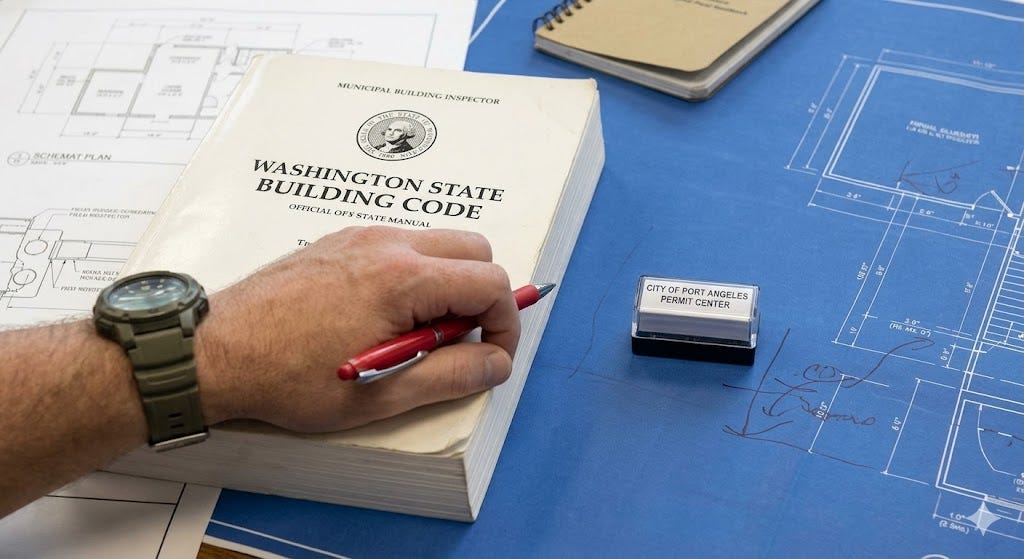
Because our local General Fund is so constrained by the enterprise fund barrier mentioned above, the City is often forced to rely on state grants and partnerships to achieve our broader housing and climate goals. However, this reliance creates a secondary challenge: we become subject to state-level regulatory schedules that operate independently of our local capacity. Under RCW 19.27, Washington is required to adopt updated international building and energy codes every three years.
As City Manager Nathan West highlighted in the 2026 State of the City Address, “the pace of every three years making those changes is just too much”. This creates a compliance treadmill that impacts us in three critical ways:
For the Developer: Construction science evolves rapidly, but architectural plans have a short shelf life. If a housing project is delayed by six months due to financing and a new three-year code cycle begins, the entire project may need a costly redesign to meet new energy or seismic standards before a permit is even issued. This adds thousands in soft costs before a shovel ever hits the ground.
For the Homebuyer: Each cycle progressively raises the bar for energy efficiency and materials. While these are important climate goals supported in our 2025-2045 Comprehensive Plan, they make Missing Middle housing harder to build. A local builder trying to put a duplex on a city lot may find that the cost of new state-mandated energy systems makes the project financially unfeasible.
For the City Capacity: Our staff must undergo massive retraining every 36 months to stay current with hundreds of pages of new regulations. This creates a periodic bottleneck in the permit center. Because the State provides no funding for this administrative burden, it is an unfunded mandate that slows down the very housing we want to encourage.
The Legislative Gap: Carbon Credits, Street Medicine, and Failed Offsets
If the three-year code cycle represents a fast mandate, the failure of state legislation represents a slow crisis where the City is left to carry regional burdens alone. This is most visible in the Legislative Gap. In my essay Forestry, Finance, and the Future of Our Watershed, I discussed the push to modernize how we fund public services through carbon sequestration.
It is important to note that while the City supported legislation to allow the use of carbon credits instead of logging state forest lands to fund junior taxing districts, those bills did not make it through the State Legislature this session. This is a significant moment for Port Angeles. When the State fails to provide an alternative revenue stream like carbon credits, local communities are left with a difficult choice: continue logging critical watersheds to fund our schools or face a massive tax shift onto local property owners to fill the gap.
This pattern of failed legislative offsets happens in many spaces. For example, our 2026 Legislative Agenda requested an expansion of Street Medicine Program funding. While the State updated some Medicaid rules for existing programs, it failed to provide the new funding needed to bring those services to Port Angeles.
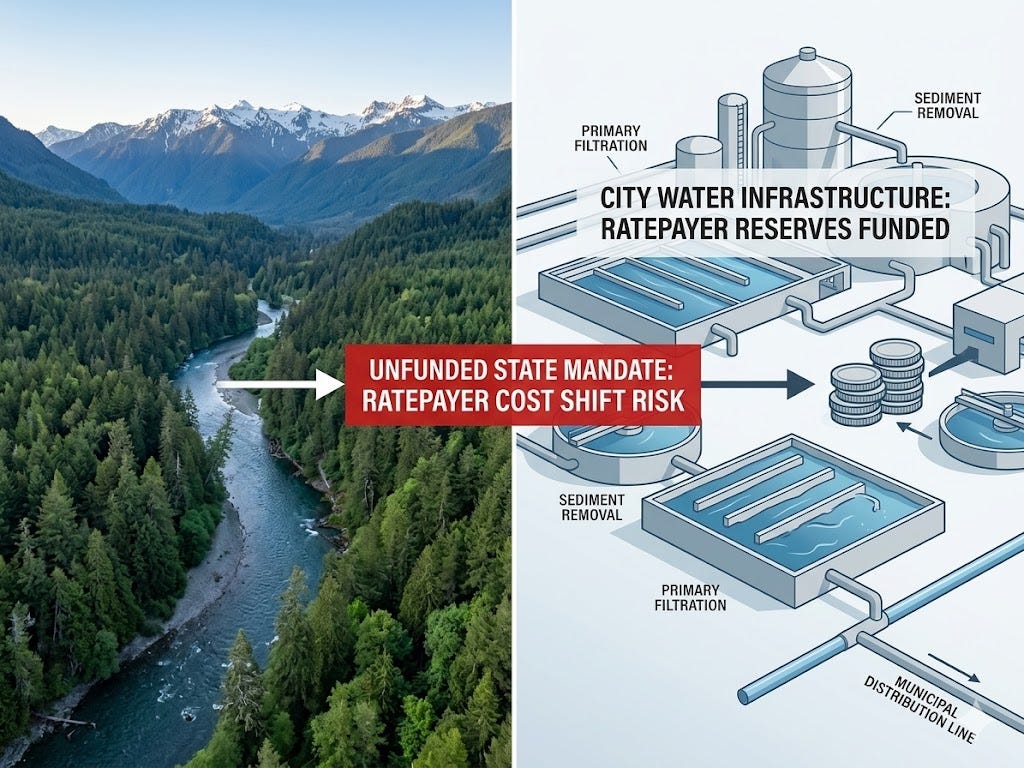
Similarly, our request for state partnership on a Solid Waste Compactor Baler went unfunded. Because this tool is essential for operational efficiency and saving $250,000 in annual hauling costs, the City has already stepped up to fund it through our local utility reserves. This is the definition of an unfunded mandate in reverse: the State sets high environmental and efficiency standards, but when they fail to partner on the tools, the cost of meeting those standards is shifted entirely onto the local Port Angeles resident.
Case Study: The Lower Elwha Klallam Tribe (LEKT) Sewer Project
While these legislative gaps and regulatory treadmills create significant friction, we also have models for how to overcome them through deliberate partnership. The LEKT Sewer Project is the counter-argument to jurisdictional gridlock. This project is a multi-jurisdictional effort that spans city limits and urban growth areas. As I noted in my 2026 Legislative Priorities essay, the City is seeking $3.25 million from the State to complete this work.
This is Strategic Interdependence in action. The Tribe has funded the design, and private employers have invested nearly $1 million. By connecting this to the City wastewater system, we unlock hundreds of acres of industrial land for economic development. This is how we grow our way out of fiscal constraints: through regional partnerships that solve infrastructure bottlenecks no single government could fix alone. It proves that while our jurisdictions are separate, our economic destinies are shared.
Conclusion: The Map for April 7
As we move toward the April 7 Work Session, we must be disciplined about our role. Success in that meeting requires us to stay within the legal and regional guardrails I have mapped today. If we approach the complex intersection of housing, homelessness, and encampment response expecting the City to override the County role or ignore the State restrictions on fund accounting, we will produce a policy that is performative rather than functional.
My goal for that session is to identify the specific levers the City does control — such as land-use code, public space ordinances, and coordinated outreach — while continuing to hold our regional partners accountable for their side of the matrix.
As the Urban Institute research on City Resilience suggests, the most successful cities are those that understand their technical limits and maximize their regional partnerships. Next Saturday, April 4, I will look at the final piece of this puzzle: the specific legal architecture — including the Martin v. Boise ruling — that will govern our upcoming votes.